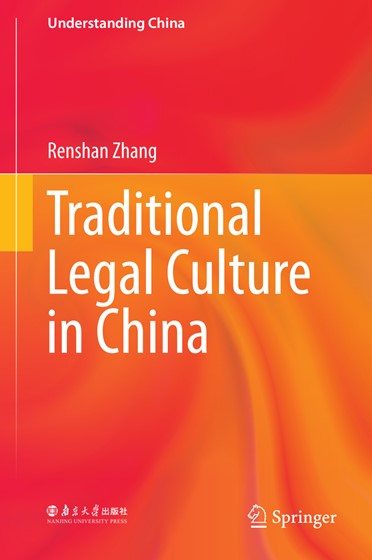
张仁善教授《中国法律文明》一书的英文版日前由Springer公司出版,全球发行,并提供线上电子版下载。该书属于Springer出版公司“了解中国”(Understanding China)书系(//link.springer.com/series/11772),被出版社誉为“一本全方位介绍中国传统法律文化的著作”(A comprehensive book to offer an encyclopedic introduction to the traditional legal culture in China)。该书原由p站视频
出版社于2018年出版。2018—2021年,分别列为国家社科基金“中华学术外译丛书”英文、意大利文、日文、韩文版翻译项目。2019年国家新闻出版研究院列为建国70年百本中华学术对外推荐书目,为法学领域仅有的两本书之一。2020年获江苏省第十六届哲学社会科学优秀社科成果一等奖。该英文版为目前面世的第一部外文翻译版本。本书的出版社官方页面为//link.springer.com/book/10.1007/978-981-95-4697-8。
作者简介
Renshan Zhang is a professor of Law School at Nanjing University, executive chairman of China Institute of Legal History (CILA), chairman of Institute of Legal History of Jiangsu Province Law Society, adjunct professor at the Johns Hopkins University-Nanjing University Center for Chinese and American Studies, member of the Sino-American Joint Academic Committee (JAC), director of the Research Center for Judicial Culture, Law School at Nanjing University, editor-in-chief of the Nanjing University Law Review (2008–2017).
代表著作
His main works include:
· Law School History of Nanjing University: 1927–2021
· Modern Chinese Law Through a Multidimensional Perspective
· Traditional Legal Culture in China
· Sovereignty
· Legal Rights and Society in Modern China
· Rites
· Law and Society: Legal Transition and Social Change in Qing Dynasty
· Perspectives in Legal and Social History
· Chinese Society in 1949
· Judicial Corruption and Social Breakdown: 1928–1949
本书简介
A comprehensive book to offer an encyclopedic introduction to the traditional legal culture in China
Adopts a creative thematic structure instead of the traditional chronological approach to Chinese legal history
Renders to readers a Chinese perspective to view the world and a global framework to understand China
The book comprehensively explores the origins, structure, characteristics, functions, and unique role of Chinese legal tradition within the global scope of legal culture. It adopts a thematic framework that extends across multifaceted dimensions to examine the evolution, features and impact of Chinese legal culture, breaking away from the traditional chronological approach to legal history.
The book seamlessly integrates macro and micro views, bridges ancient and modern, as well as Chinese and foreign perspectives, and combines state law with folk law, and law with ethics. The content covers seven key aspects: the culture of rites and etiquettes, penal culture and practice, the culture of legal philosophies, the culture of a legal system, contractual culture, the culture of mediation, and the culture of justice. The topics encompass the origins of traditional Chinese law, the evolution of legal thoughts, the development of legal systems, the procedures and effects of legal practices, and the relationship between legal development and social change.
This book is primarily aimed at legal scholars, students, and practitioners who are interested in understanding Chinese traditional legal culture. It is also intended for readers with a moderate level of education or higher, who seek to understand Chinese legal history and culture.
本书目录
Contents
1.The Culture of Rites and Etiquettes 1
2.Penal Culture and Practice 45
3.Legal Philosophies 97
4.The Culture of a Legal System 151
5.Contractual Culture 217
6.The Culture of Mediation 251
7.The Culture of Justice 309
Index 377
vii
英文版序言
Preface
Renshan Zhang
The Chinese title of this book is Zhongguo Falü Wenming (Chinese Legal Civilization as the literal translation). Here, the term “civilization” actually carries a meaning closer to “culture” in this context. Thus, “Chinese legal civilization” essentially refers to the traditional legal culture in China. A fundamental distinction between the concepts of “legal civilization” and “legal culture” is that legal civilizations converge while legal cultures diverge. The standards for legal civilization are objective, measurable against benchmarks such as humanism versus barbarism, progress versus backwardness, liberty versus constraint, equality versus oppression, openness versus closedness, and democracy versus autocracy. Legal culture, by contrast, is quite inclusive, containing both commendable and undesirable aspects. Only a legal culture that is open and impartial, respectful of human nature, and inclusive can turn into a constituent piece in the mosaic of legal civilization.
Legal culture is inherently pluralistic. Throughout human history, diverse legal models have emerged. On a macro level, a number of major legal systems have been formed, such as the Civil Law system, the Anglo-American Law system, the Hindu Law system, the Islamic Law system, and the Zhonghua Faxi(中华法系), manifested primarily in the traditional Chinese legal system. These law systems have continuously demonstrated profound legal wisdom and have propelled historical progress. On a micro level, each legal system encompasses a variety of legal forms shaped by distinct regions, administrative levels, and beliefs. Together, these manifold legal cultures compose a richly varied legal knowledge graph, rendering human life multidimensional, meaningful, vibrant, and fascinating.
Conflicts are inherent in legal culture. Human history has witnessed incessant and enduring clashes between different legal cultures, intertwined with acts of conquest and resistance, colonization and decolonization, assimilation and dissimilation. Such Conflicts can arise between nations, ethnic groups, and regions, as well as between the state and its people, among families, and within neighborhoods. To prevent and resolve these Conflicts, it becomes necessary to establish relatively fair and just public rules, i.e., law, or to devise mechanisms for settling and mediating disputes, termed “administration of justice.” Legal culture has always advanced vi with difficulty through various forms of Conflicts, which, in turn, has compelled the continuous development and refinement of the means of resolving disputes.
Legal cultures are capable of fusion. During the process of prolonged Conflicts, pluralistic legal cultures are engaged in continuous comparison, mutual absorption, and competitive selection, and eventually, the most quintessential elements are often adopted by the majority and thus preserved and handed down. The process of conflict and fusion can be at times rapid, at times gradual, and can even be reversed sometimes, yet the primary trend toward fusion remains largely unchanged. It is through this fusion that legal cultures supplement each other and retain the essential, advancing the progress of legal civilization. Legal cultures develop at various paces across different epochs. However, the disparity of development paces cannot negate the fundamental homogeneity of legal civilization. This shared foundation is reflected in the principles as follows: A sound legal system must recognize every individual as a “person,” safeguarding their “personal” rights to life, liberty, property, equality, and dignity. Public power must derive from the populace, serve private rights, and be subject to stringent constraints; No one shall exercise their freedoms and rights in a manner that infringes upon the freedoms and rights of others. Virtues such as benevolence, righteousness, propriety, wisdom, fidelity, truth, goodness, beauty, friendship, and love should form the essential public morality of a healthy society.
Legal cultures develop with regional variations. However, regional differences cannot be indiscriminately overemphasized, under the pretext of preserving regional characteristics to justify adherence to legal-cultural practices that history has proven backward or even barbaric, including rigid hierarchies, male supremacy, inhumane chastity and filial piety rituals, interrogation by torture, and judicial injustice. Rejecting the fruits of advanced legal civilization under this guise is equal to fundamentally denying the universal applicability of legal civilization itself.
Traditional Chinese legal culture holds a unique position in the world’s legal systems and has made profound contributions to the advancement of global legal civilization. Its finest elements, no matter whether in the past, at present, or in the future, remain treasures within the long river of world legal heritage, shining brilliantly across time and space. Conversely, those dross elements that fall out of step with the progress of contemporary legal civilization demand critical refection and deliberate abandonment.
It is the foundational purpose of this book to enable traditional Chinese legal culture to achieve renewal through inheritance and purification, thereby continuing to contribute to the continuous advancement of human legal civilization.
Lastly, I wish to express my profound gratitude to Ms. Wang Haiping for her diligent translation efforts. With her assistance, a number of errors in the original manuscript have been corrected.
Nanjing, Jiangsu, China, October 8th, 2025